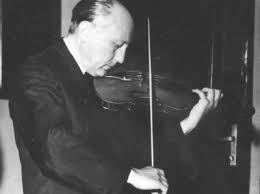




Mirella Balliana
Mayor Vittorio Veneto
History of the Competition
The “Città di Vittorio Veneto” National Violin Competition was established in 1962 through the initiative of several local enthusiasts: Professor Antonia Pallavicini (President of the “Amici della Musica” Association of Vittorio Veneto), Cavaliere Vittorio Costantini, and Cavaliere Arturo Pasqualis (President of the Independent Stay and Tourism Board, the first organizing body of the event). The competition was conceived and coordinated by Mario Benvenuti (1915-1995), a violinist and violist from Conegliano, a world-class performer and teacher, and a member of the “Quintetto Chigiano,” the “Sestetto Chigiano,” and the “Virtuosi di Roma.” In September 1962, the first edition of the “Città di Vittorio Veneto” National Violin Competition took place with contributions from the Municipality, the Province of Treviso, and the Provincial Tourism Board. The event was held annually until 1972, after which it became biennial.
After the initial editions, Maestro Benvenuti had the brilliant intuition to pair the Competition with an event dedicated to young and very young musicians. Thus, in 1964, the Review for student violinists was launched, followed by reviews for violists (1977), cellists (1979), and double bass players (2004). Also noteworthy are the reviews for String Trio, Quartet, and Quintet, as well as the extraordinary competitions for duos held in certain editions.
From an organizational and artistic perspective, the long and qualified contribution of Fiorella Foti was decisive; she served as General Secretary and Artistic Coordinator from 1971, later taking on the Artistic Direction, a role she held until 2005. The presence of Tiziano Forcolin was also significant, as he worked alongside Fiorella Foti from 1969 to 1990 as Organizational Manager.
Subsequently, the artistic coordination of the competition was entrusted to the Vittorio Veneto composer Stefano Da Ros (2007, 2012, 2014, and 2020 editions) and to Roberto Zarpellon (2010). The last two editions of the national competition (2012 and 2014) were directed by Massimo Quarta, an internationally renowned violinist and winner of the Vittorio Veneto Competition in 1986.
For over 50 years, the Vittorio Veneto violin competition has seen generations of violinists pass through its doors and has represented the main point of reference for Italian string instrument schools. For the winners (whose names are listed in the Roll of Honour), the first prize achieved at the “Città di Vittorio Veneto” has represented an authentic springboard for brilliant careers in performance and teaching.
In every edition, the finest violinists on the Italian scene, as well as established composers, conductors, and musicologists, have been called to join the jury. Leading figures invited to chair the judging panels include: Marcello Abbado, Luciano Chailly, Giorgio Ferrari, Ettore Gracis, Virgilio Mortari, Goffredo Petrassi, Leonardo Pinzauti, Massimo Quarta, and Uto Ughi.
Until 2010, the artistic direction was entrusted to a committee that saw various changes over the years, including internationally famous musicians such as Salvatore Accardo, Mario Brunello, Giuliano Carmignola, Piero Farulli, Rocco Filippini, Bruno Giuranna, Claudio Scimone, Renato Zanettovich, and Piero Toso.
Since 1970, the competition has utilized prestigious orchestras for the gala concert of the top-ranked finalists and the final round of the competition: the Haydn Orchestra of Trento and Bolzano, the Salzburg Mozarteum Orchestra, the Orchestra of the Teatro La Fenice in Venice, the Orchestra Filarmonia Veneta of Treviso, and the Orchestra di Padova e del Veneto.
From 1999 to 2010, the Competition and Reviews were members of the E.M.C.Y. (European Union of Music Competitions for Youth), an organization that brings together the main European competitions for young musicians.
In 2020, after a six-year hiatus, the Municipality of Vittorio Veneto decided to resume the Competition and relaunch it with an international dimension, targeting young talents from the European Union. The artistic direction was entrusted to Francesco De Angelis, an acclaimed violinist (winner of the “Premio Città di Vittorio Veneto” in 1993) who, in 1998, following an international competition, was chosen by Riccardo Muti to serve as Concertmaster for both the Orchestra of the Teatro alla Scala and the Filarmonica della Scala (roles he still holds today). He is a professor at the Lausanne University of Music, Sion site (Switzerland).
In 2021, the first European edition recorded (despite the Covid restrictions still in force at the time) 60 applicants representing 13 EU Member States, with the Italian Vikram Francesco Sedona being crowned the winner; the second prize was awarded to Ispir Luka from France, and the third prize to Siles-Mellinger Andreas from Germany. A special merit diploma was awarded to Taisiya Zinova from Latvia. In 2023, 64 young violinists registered from Germany, Poland, Austria, France, Romania, Spain, Belgium, Estonia, Latvia, Portugal, Slovenia, Sweden, and of course, Italy. The winner was Eva Ter-Sarkisova (19 years old) from Latvia, with the second prize going to Magdalena Sypniewski (27 years old) from France, and the third prize to Francesco Papa (17 years old) from Italy.
Since the very first European editions, the prize pool has been enriched by numerous concert-prizes offered to the winner by top-tier institutions and orchestras, such as the Teatro alla Scala Foundation in Milan and the Teatro La Fenice in Venice.
For the 2026 edition, Maestro Francesco De Angelis (Artistic Director) and Maestro Stefano Da Ros (Artistic Coordinator and Jury Secretary) have been confirmed in their respective roles.
A Greeting from Mario Benvenuti in 1988
One day, towards the end of 1960, I received a visit from Miss Antonia Pallavicini and Mr. Vittorino Costantini, two animators of cultural and musical activities in Vittorio Veneto during those years. They presented me with the idea of establishing a national competition for singing and asked for my advice on the matter. I informed them of my willingness to direct them to an expert, given that singing was certainly not my field. At the end of the pleasant conversation that followed, an idea flashed through my mind, which I expressed to them instantly: why not think about a violin competition instead? The proposal found them immediately enthusiastic (Mr. Costantini, among other things, had studied violin for some time under the guidance of Maestro Guarnieri).
We then began studying the project: I took it upon myself to draft the first version of the regulations, for which I also consulted with several colleagues, including Alberto Poltronieri, and in 1962 we launched the first edition of the competition. Thanks to extensive promotion, including personal relationships, participation was satisfying, as was the interest generated among the press and the public. Unfortunately, the success was not repeated the following year, and the organizers, somewhat discouraged, were almost tempted to abandon the path they had taken.
Before such a drastic decision, however, we decided to conduct a fact-finding survey at conservatories and musical institutes through a questionnaire. The responses unanimously urged us to continue. To encourage an approach to the violin and at the same time ensure a “turnover” in participation, we then devised a review for students, which after the first few years would prove to be a winning horse. Initially, it was reserved only for violin students and divided into just two sections; later it was expanded to younger students and subsequently to students of viola and cello.
At this point, I must emphasize the great openness with which the organizing body has always welcomed the proposals that were gradually developed: my thoughts go in particular to Cavaliere Pasqualis, Mr. De Bastiani, Professor Tolot, Engineer Barbantini, and Mr. Pellizzaroli.
Particular care of the Vittorio Veneto Prize has always been the selection of the members of the various judging panels. The names that have alternated testify to this diligence: from Petrassi to Gulli, from Materassi to Poltronieri, from Mortari to Carmirelli, from Ferro to Ughi and Accardo, to name a few.
I remember the early editions of the competition, when the three jurors were hosted in an atmosphere of familiarity and friendship, and it was not uncommon for them to be almost vied for in convivial gatherings at the invitation of local enthusiasts. Today this is no longer possible, given the scale the event has reached, but the cordial and friendly atmosphere has remained intact, as noted every year by the friends on the various committees.
It only remains to hope that the event can continue on the path traced back in that distant ’62, preserving its original purpose: to provide a valid contribution to the artistic formation of young musicians through a useful exchange of study and life experiences.
Mario Benvenuti (1988)
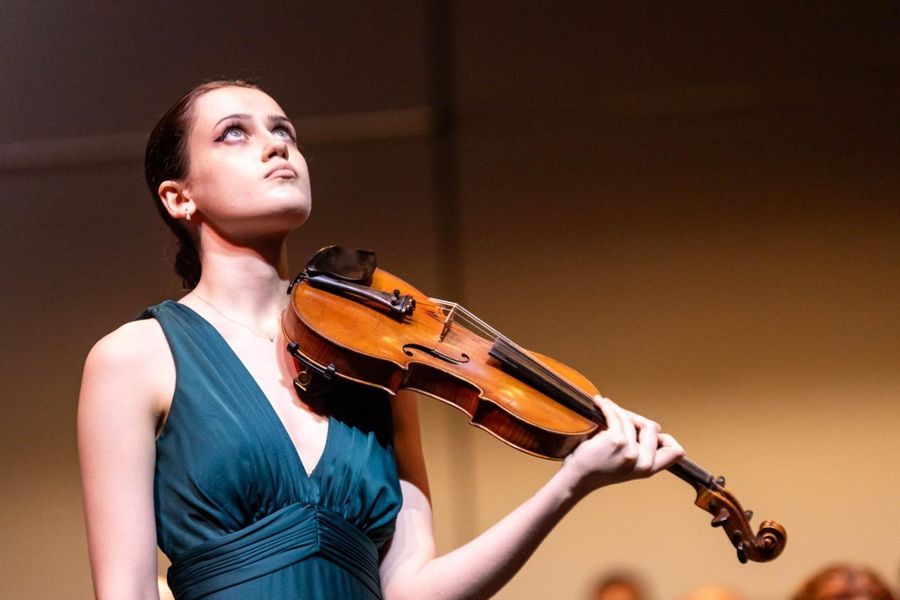
Eva Ter-Sarkisova, winner of the 33rd edition
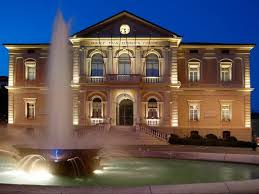
The organization
President of the competition
City Councilor for Culture of the Municipality of Vittorio Veneto
Enrico Padoan
Artistic Director
Francesco De Angelis
Artistic Coordinator
Stefano Da Ros
Organizing Secretariat
Culture Office of the Municipality of Vittorio Veneto
Piazza del Popolo, 14 – 31029 Vittorio Veneto (TV)
tel. +39 0438 569315 / 569312 / 569332
violino@comune.vittorio-veneto.tv.it
The founder
Mario Benvenuti (1915 – 1995)
He earned his diploma in violin in 1935 and in viola in 1936 at the Benedetto Marcello Conservatory in Venice. He began his career as a soloist and in a duo with his brother Arnaldo (a pianist and composer who died prematurely in 1942). He completed his postgraduate studies at the Accademia Nazionale di Santa Cecilia in Rome and subsequently at the Accademia Chigiana in Siena. In 1939, with the encouragement of Count Chigi Saracini, the Quintetto Chigiano* was formed; through extensive concert activity, the ensemble achieved significant international renown. In the mid-1950s, Mario Benvenuti left the Quintet to join the chamber orchestra Collegium Musicum Italicum (later known as I Virtuosi di Roma) conducted by Renato Fasano. In 1966, he co-founded the Sestetto Chigiano*, which—through meticulous and passionate research and study—introduced audiences in Europe and America to a repertoire ranging from the late seventeenth century to contemporary composers such as Martinů and Malipiero.
Alongside his performing career, he maintained a constant and significant commitment to teaching, initially at the Pesaro Conservatory and later—until his retirement—at the Benedetto Marcello Conservatory in Venice. His teaching was marked by an absolute dedication and a drive to nurture the individual talents and diverse personalities of his students.
* Violins: Riccardo Brengola and Mario Benvenuti; Viola: Giovanni Leone; Cello: Lino Filippini; Piano: Sergio Lorenzi
** Violins: Riccardo Brengola, Giovanni Guglielmo (first winner of the Vittorio Veneto National Competition) / Felice Cusano; Violas: Mario Benvenuti and Tito Riccardi; Cellos: Adriano Vendramelli and Alain Meunier